Madrid
I visited Madrid for a short break in May 2023, I did not have much on my mind to do as I was quite busy at the time and wanted to take it easy whilst I was there. The flight out there was with Iberia, and apart from a little wobble descending into Barajas, it felt like we had not moved!
El Valle de los Caídos (Valley of the Fallen)
El Valle de los Caídos, which translates to "The Valley of the Fallen" in English, is a monumental site located near Madrid, Spain. It is a basilica and a memorial built into the mountainside to honor the victims of the Spanish Civil War. Constructed between 1940 and 1958 under the direction of General Francisco Franco, the site contains a vast underground crypt, and a colossal cross stands above the basilica. The controversial monument has been the subject of historical and political debate due to its association with Franco's regime.

The surrounding area of El Valle de los Caídos is a picturesque and natural setting in the Guadarrama mountain range, located about 50 kilometers northwest of Madrid. Nestled amidst lush forests and rocky terrain, the monument offers breathtaking views of the Spanish countryside.
Las Ventas
Las Ventas is a famous bullring in Madrid, Spain. It is one of the most iconic and significant bullfighting arenas in the world. Completed in 1931, it can seat over 20,000 spectators and hosts numerous bullfighting events, especially during the San Isidro Festival, which is one of the most important bullfighting events in Spain. Las Ventas is not just a venue for bullfights but also a cultural landmark that reflects Spain's historical connection with bullfighting.

Rejones
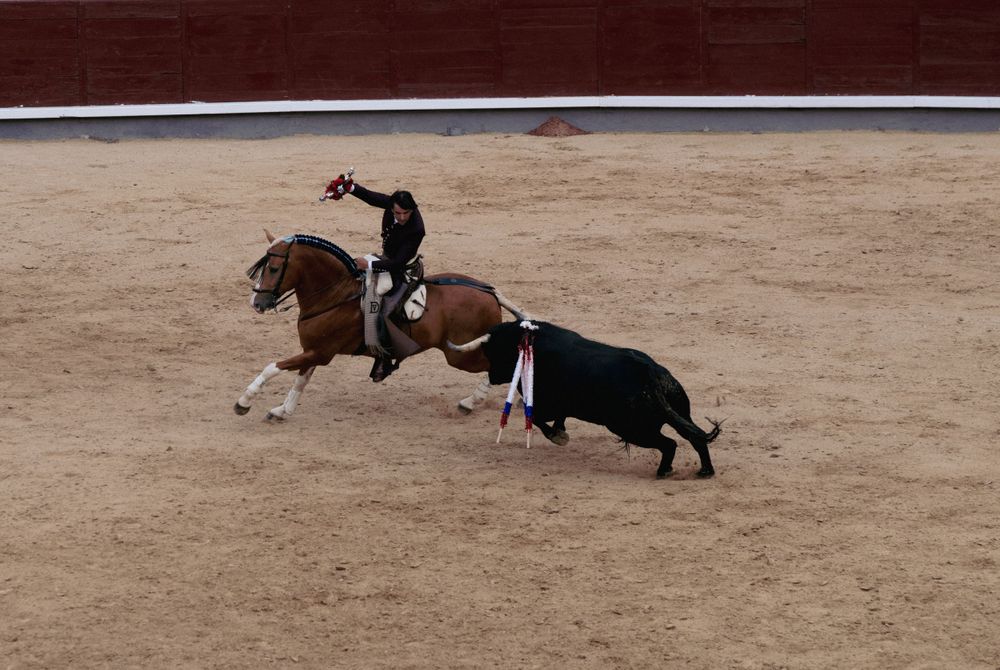
I watched a Rejones (Bullfight on Horseback) on the Saturday. The arena was packed, not a spare seat could be seen (thankfully the Americans in front of us left early though). Going to the fight was more of a morbid curiosity than anything, and it started off with the traditional music and presentation of the bullfighters. Shortly after, the first fight started, and it was an insane display of horsemanship, skill and brutality. The second fight turned out to be more of a show of entertainment than a life or death situation, with the fighter teasing the bull at every opportunity alongside dozens of heart stopping intentional near misses with the bull - owing to years of experience under his belt.
You get the idea of what happens next, but one of the fighters had it nailed to perfection, jumping off his horse and gesturing to the bull, "I have won" followed by the bull collapsing into a heap. The crowd then cheered heavily for each fighter - and if they had done well they were given an ear of the bull - or two if they put on an amazing performance.


Palacio Real
The Palacio Real, also known as the Royal Palace, is an impressive and grand palace located in Madrid, Spain. It serves as the official residence of the Spanish royal family, although it is primarily used for official ceremonies and state functions today. Built in the 18th century, the palace showcases stunning architecture and opulent interiors, housing an extensive collection of art and historical artifacts. With its rich history and magnificent design, the Palacio Real is a must-visit attraction that offers a glimpse into Spain's royal heritage.


Retiro Park (Alfonso XII Monument)
The Alfonso XII monument is a prominent and majestic structure located in Madrid's Buen Retiro Park. Erected in honor of King Alfonso XII of Spain, it stands as a magnificent monument near the beautiful artificial lake in the park. The monument features a massive equestrian statue of King Alfonso XII on horseback, surrounded by intricate sculptural elements and decorative fountains. The monument's striking design and picturesque setting make it a popular spot for visitors to admire, relax, and enjoy the scenic beauty of the park.

Schweppes Neon Sign
Before I explain, I did indeed stand there for 10mins to get that photograph!
The Schweppes Gran Vía sign in Madrid is a famous and iconic neon advertisement located on the Gran Vía street, one of the main thoroughfares in the city. The sign, which features the word "Schweppes" in bold red letters, has become a landmark and symbol of the Gran Vía area. It is a well-known meeting point for locals and tourists alike and is often used as a reference when giving directions or arranging to meet someone in the bustling heart of Madrid. The sign's vibrant colors and historical significance have made it a beloved fixture of the city's urban landscape.

Faro de Moncloa // Moncloa's Lighthouse
The "Faro de Moncloa" is a prominent landmark located in the Moncloa-Aravaca district of Madrid, Spain. Translated to English, "Faro de Moncloa" means "Moncloa Lighthouse."
The Faro de Moncloa is an observation tower that stands at a height of approximately 110 meters (360 feet). It was constructed in 1992 to mark Madrid's designation as the European Capital of Culture. The tower was designed by architects Salvador Pérez Arroyo and Julio Martínez Calzón.
Originally, the tower served as a functional lighthouse, but its primary purpose today is as an observation deck offering panoramic views of the city of Madrid. Visitors can ascend to the top of the tower via an elevator and enjoy stunning vistas of the Spanish capital, including notable landmarks such as the Royal Palace, Plaza de España, and the Cuatro Torres Business Area.

Puerta de Alcala
The Puerta de Alcalá is a historic monument located in the city of Madrid, Spain. It was constructed in the late 18th century during the reign of King Charles III. The monument serves as one of the iconic landmarks of Madrid and is situated in the Plaza de la Independencia, near the city center.
Designed by architect Francesco Sabatini in a neoclassical style, the Puerta de Alcalá is a grand triumphal arch with five archways, adorned with decorative elements such as reliefs and sculptures. The monument was originally built as a gateway to the city and served as a symbol of welcome for travelers arriving from the direction of Alcalá de Henares.
Throughout its history, the Puerta de Alcalá has witnessed significant events and ceremonies, including royal processions, national celebrations, and political gatherings. Today, it stands as a symbol of Madrid's rich history and cultural heritage, attracting tourists from around the world who come to admire its architectural beauty and historical significance.
